
Development Consortium (DC) is a not-for-profit organisation founded in 2006 by Anamika Srivastava and a small circle of close collaborators, committed to social innovation, inclusion, and systems change. Operating under the conviction that "together we can," DC works with children, women, and vulnerable communities to overcome poverty, inequality, abuse, and injustice.
DC pursues its mission through two complementary models: Idea to Impact, where it incubates and runs programmes in education, nutrition, mental well-being, gender equity, and adolescent health; and Adapt and Amplify, through which it partners with proven organisations such as Fortify Health, Suvita, Nazariya, Dhanak, Safehub, STEP, Ansh, Kaya Guides, LEEP, and MELA to scale interventions across geographies.
Through this model, the Development Consortium has:
- Reached communities across 14+ states in India
- Benefited 14 million people through offline programmes
- Engaged 11 million people through online initiatives
- Built a portfolio of 7 incubated programmes and 10+ adapt-and-amplify partnerships
Metrics based on partner-reported data. Last updated: May 2026

Koita Foundation Partnership with DC
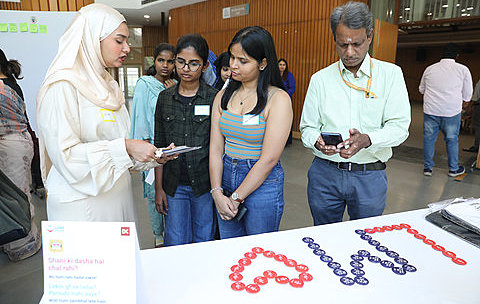
Development Consortium runs Love Matters, India's leading digital Sexual and Reproductive Health and Rights (SRHR) platform for young people - delivering open, non-judgmental, science-based information on love, sex, and relationships. Its latest innovation, Ask Love Matters, is an AI-enabled WhatsApp chatbot that provides confidential, personalised SRHR guidance in multiple languages, 24/7. Built on Love Matters India's proprietary expert-curated knowledge base, it uses WhatsApp's familiar interface to reach young people in rural and semi-urban areas with limited digital literacy - with trained experts stepping in when nuanced support or service referrals are needed.
Koita Foundation is supporting the Development Consortium in scaling Ask Love Matters by expanding its reach in rural and peri-urban areas through digital marketing and offline outreach. The Foundation has also helped DC build a robust impact evaluation framework, including metrics, analytics, and dashboards to measure adoption and outcomes.